Wednesday, 12 June 2013

Campaigning for the Coast


Worth protecting
Regular readers will know that I have been involved with a non profit organisation called the Dogwood Initiative (named after BC's provincial flower) for the last few months. I wrote emails, attended events and even waved a placard in support of their campaign to protect BC's coast from the threat of oil spills in 2012. But with a provincial election in 2013 (pretty critical in a federal system) it was time to take the next step - volunteer to lead a team in my 'riding' of North Vancouver-Lonsdale.

I had always admired the campaigners at Save the Children (the international development charity I worked for in the UK).  So creative, energetic and ready to get out and talk to people who might not agree with them.  But I'd always been the goal oriented project manager whose only role seemed to be to hassle them for clearer targets and their final results.  Could I actually campaign myself and encourage others too?

Leap without looking
So without giving myself time to think, I clicked 'yes' to the email invitation and put a pin on the virtual map with my details and a team name (very original: North Van for the coast).  I emailed Dogwood HQ with an honest assessment of my skills and experience: great organizer, loves politics, no campaign experience and as an immigrant, poor networks in the city. I'm not sure how delighted they were, but they sent a very encouraging and informative reply back.
Tanker in our local inlet

Why was I doing it?
In short, letting the world's dirtiest oil travel across mountains and rainforest via pipelines to be loaded into supertankers who then have to navigate one of the worlds most dangerous coastline obviously makes no sense for the environment. But exporting raw resources with no refinery profit or job creation also makes no economic sense.

For a longer answer, check out the final section!

Brainstorming and building networks
So that's the why, but what did we actually do? First job for me was to read Dogwood's awesome campaign kit; tons of info, planning tools and tips and activity guides.  We had three main jobs:

1. Form a team
I found this the hardest part. After roping in my other half and some close friends, it was time to reach out to other Dogwood supporters over email.  Lots of people were supportive but already involved in other volunteer work. Making links over email was hard - as soon as I met up with people it was so much easier to build a relationship and get them to take action.

In hindsight, my first step would have been to organise a quick get together to just meet people, without the pressure of asking them to help organise anything.  But I also should have worried less if people weren't keen to organise at first, and just try to get them to come to one event.

But a handful of us managed to form a plan to get to step 2.

2. Contact the candidates for the election and get their positions
Post gym preparations
A couple of us researched the party and candidate's positions, using Dogwood tools and then contacted them, tailoring the template and adding our own personal experiences.

The NDP opposition candidate (equivalent to UK Labour) got back quickly with a detailed response. The incumbent Liberal candidate (pretty much a UK Conservative equivalent) took much longer and, for the supposed greenest MLA, with a pretty pathetic reponse.

We used these as a basis for step 3.


3. Tell people in the riding the candidates' positions and encourage them to vote to protect the coast

Our key ways were through door knocking and phoning. Again in hindsight, I would have organised these earlier to get people to at least one, this would have built momentum and repeat participants. But we managed to get out five times, covering about 1000 households.

Our leaflets showing the different parties' positions
Everyone really enjoyed it: most people supported us, and those that didn't were polite and even thanked us for getting out for democracy.  It helped we started by asking people to sign a petition against tankers, and then told them the candidates in a non partisan way. It was interesting watching how reactions changed: in week 1 people were very undecided on who to vote for, by week 4 (just 6 days before the election) people were more defensive as they'd often been contacted by several of the parties.

Definitely not for anyone with a phobia of dogs. But as everyone in Vancouver seems to have their own, I can't imagine this would be an issue for most!  Highlight was people thanking us so profusely for being out there.  Lowlight was realising even a North Face waterproof is no match for a BC monsoon...

Phoning was less fun: its harder to not be nice to a smiley volunteer on your doorstep in the rain, easier to an anonymous voice on the phone. But one Dogwood supporter was delighted to see his donation being put to work and it was definitely quicker per household.

What did we achieve?
Well, what we wanted was for British Columbians to vote for one of the two parties who opposed pipeline expansion. But people vote for a whole variety of reasons and, contrary to every poll, the Liberal government remain in power.

But, a couple of weeks later, the Liberal government submitted their final response to the environmental review of the Enbridge pipeline project... and they opposed it!  In 2011, no one was talking about oil or pipelines and the project seemed a dead cert. In contrast, during the 2013 election, it was a top issue with questions to leaders, candidates, and lots of column inches and air time. The Liberal government felt the pressure and voiced their opposition.  The pipeline isn't dead yet (the current federal Prime Minster is from the oil patch) but BCers are now highly aware of the issue and the majority oppose it. Hundreds of people volunteered for and donated to Dogwood, and other environmental groups, and these individuals are now more engaged and motivated to keep fighting.

As I make my preparations to return back to the UK, I will be taking back my committment to the cause. If the world is serious about preventing more climate change, a good place to start is helping BC be Canada's conscience and stopping Alberta's tar sands leaving the ground...

Tar sands bitumen; needs diluting to travel by pipe
Why I did it, the long answer:
The world's dirtiest oil is drilled in our neighbouring province of Alberta (think Texas without the death penalty). It takes 5 gallons of water to drill 1 gallon of heavy bitumen oil, making the water too toxic to return to the water table (so it currently sits in giant lakes waiting for a scientific solution).

The oil companies and the federal government want to access Chinese markets by building more pipelines to Canada's west coast. To do it, they want to lift the ban on the huge 'Suezmax' tankers moving through BC's treacherous coastal waters. And overcome the mounting and loud opposition in BC.

Its a no brainer its terrible for the environment:there's a high chance of a spill from a crashing tanker (think Exxon Valdez); certain spills from the pipelines through BCs northern wilderness (the oil companies have a very poor record of clean up); and it encourages development of the climate changing and water source ruining Alberta tar sands.

Cleaning up the Exxon Valdez spill, just north of BC
But it also doesn't make economic sense for BC. Sure, the increasingly foreign (mainly Chinese) owned oil companies will get a higher profit from every barrel, but that just means higher oil prices in Canada. Not investing in refinery capability means very few real jobs are created. And its not a long term plan for Canada's future: it ships off their highest value commodity at low prices, why not refine in house and allow slower development so Canada can, if it still wants to build an economy based on fossil fuels, at least make some money out of it?

You can find more information (and sources) here.

Tuesday, 14 May 2013

Hummingbirds, hippies and hikes

The first cruise ship just docked in Vancouver downtown which means summer has officially begun.But we've actually already had a summer-like spring, here are the highlights:

An Easter weekend of tree frogs, hummingbirds and hippies

UntitledNo, we didn't visit Costa Rica, just my relatives on Vancouver Island. Just a word on 'the Island' as its known here in case you're imagining something Isle of Wight like - its roughly the same size as England, but is populated by the wolves, cougars, bears and is the most left wing place in BC (and probably Canada).

A day with my cousin, the incorrigible EC Pielou (pioneering ecologist with her own wiki entry, which does not do her justice), who at 88 delighted in choosing the steepest trail for our morning hike.  Then on to my cousins Richard and Joyce on the even wilder Quadra Island. Our first Canadian 'pot luck' turned into a barbecue on their friends' deck, only retreating inside when the sound of the hundreds of treefrogs inhabiting their wetland property became deafening.

UntitledHummingbirds are incredibly territorial, in spring the crimson throated male Anna's hummingbird is busy protecting the best food sources ahead of the mating season. The Pielous' new arrival did not appreciate Mark's efforts (you can guess at whose behest) to get the perfect photo, but he kept his cool amid the close shaves to get a pretty awesome one.

And mustn't forget the hippies: Mark had to work Easter Monday so my friend Dan and I took the ferry to the 'Sunshine Coast' (rainshadow of the Island) and cycled its quiet roads past beaches, rocky headlands and hippy cafes (BCs biggest export is growing marijuana "BC bud" and there's plenty of domestic consumption...) Those of you who have visited us know that under no circumstances can one sit inside on a ferry crossing in case you miss a marine mammal sighting - it paid off yet again with three dolphins on the way home.

Hiking training

Sounds odd, who has to train for hikes? But with my niggling ankle injury (an ultrasound, MRI and specialist eventually showed a strained tibial and other foot tendon but nothing too serious) meaning no running for months I was becoming increasingly nervous about the multi day backpacks we had planned for our two month summer road trip.  Gym work had definitely strengthened my legs, but now it was time to get on the trails...

In classic Marshall style I planned a 10 week program, increasing the hike length by 1 hour a week. It was a good test of my footwear (rubbish - now trialling a new pair), new orthotics (excellent) and self reliance (well mainly not having anyone to witter to). The latter was solved by meeting a very nice hiking companion on hike 3 (esp lucky as the falling snow meant my hands got too cold to do up my jacket), listening to Ironman world champion Chrissie Wellington's biography and numerous episodes of In Our Time (though even I lost interest in the assasination of Tsar Alexander).

PhotoNow up to 7 hours, 22km and 1100m of elevation gain on the very rough north shore trails so, tw, all should be well.

Camping and campaigning

First camping trip with Mark to Alice Lake Provincial Park. Out of practice we forgot essentials like an axe for firewood but managed to borrow from neighbours and had first outdoors cook of the year, yay!

And lots of campaigning to persuade people to vote to protect the coast in the elections on May 14 (but that deserves its own post...)

So next up is a May long weekend trip a couple of hours north to climb, camp and horse ride. No bears yet for 2013 so fingers crossed...

Sunday, 7 April 2013

Winter round up

It's been a while (ok, several months) since my last post and that's because I don't like to post unless there is something new to say. And I've only collected new things to say at the rate of about two a month.  So here are the December to March highlights:


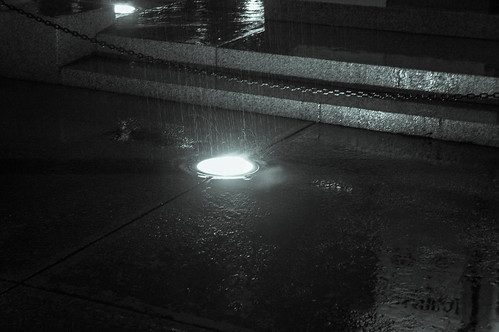
Rain and hot lights and the war memorial
Rain at the war memorial on my way home from the gym
A lot of rain. Almost every day. For three months.  Just as we were building the arc, it eased off and worst seems over now and as it was 18 degrees at Easter weekend, cannot really complain given the UK's winter.


Serious gym time. Learning to ski and trail run in one season was a challenge for my legs.  About 50 gym sessions have made my legs stronger and, weirdly, straighter. Started running again last week and back in the mountains soon to get ready for our summer trip...
First rays
Sunrise at from Grouse Mountain, Mt Baker, WA in the distance

Plenty of skiing. We had season passes for a different, more challenging, local mountain. I took lots of lessons because I love lessons, Mark didn't but was, annoyingly, almost as good.  We conquered moguls (no style, but can get down them), did the double blacks and even a few blacks at the way more hardcore Whistler. We skiied at sunrise and sunset with the coast mountain range and the ocean bathed in golden light. A winter without weekly skiing now seems strange: Milton Keynes snow dome anyone?


Me, last summer, looking at the complex coastline
Campaigning for the coast. As you saw from my last post, BC has a pristine rainforest clad northern coast which is threatened by a mega oil pipeline from Alberta's tar sands to the coast and the huge tankers which would transport the oil to China.  It doesn't make economic sense (Canada loses the benefit of refining the oil) let alone the environmental damage.  

So in February I volunteered to lead a North Vancouver group to make it a huge issue in the upcoming BC election. Email campaign, door knocking and an event planned to persuade both main political parties to say no. Bit nervous as a new kind of project me, so fingers crossed, will update you after the election!

Untitled
From Port Townsend pier, back to the same Mt Baker but 200km south (it's a big mountain)
A musical note
I don't remember this photo being taken
A pretty awesome ten year anniversary mini break.  I know: 10 years. Spent the weekend in a rain shadow (v important to know location of these) in Port Townsend, Washington state. Beautiful hotel, lovely walks and I pretended I was 21 again and got a little too merry at our romantic dinner out.  Mark got me an amazing present of a box of 100 mini cards, each printed with a photo from our first ten years; I cried.


And now the blossom is out, the daffodils are up and spring has sprung. Next post is about our glorious Easter weekend, meanwhile, here is a picture of the morning commute:
Seabus Commute
"Seabus" from North Vancouver to downtown
p.s. Noticed the quality of the photos has gone up?  That would be Mark's new hobby, check out his own photo blog here: Letsclearuplater blog


Saturday, 8 December 2012

Fall in Vancouver: Rain, placards, pancakes... and a bit more rain


Summers are long, sunny and dry in Vancouver and this one lasted well into October.  After getting back from our States road trip we had plenty of time to hike in the local mountains, show our friend Lucy the local celebrity wildlife and 'out-camp' the Provincial Park system by camping after it had technically closed (who needs running water anyway?).
Our penultimate trip to Garibaldi lake


But, on the day our friend left, the heavens opened.  Eight weeks of pretty consistent rain followed, sometimes heavy, sometimes light, sometimes just showers; but definitely water falling from the sky.  Now we're past the 40 day mark, I am wondering whether it might be sensible to commence arc construction...


Anyway, enough whingeing. Without the outdoors not exactly out of bounds, just a bit less fun, what have we been up to?


Good ol' leftie activism

notankers.ca loonie
Neat stickers to put on dollar coins
Canada has one of, if not the, most incredible and pristine landscapes left in the world.  Unfortunately some of it has immense amounts of very dirty, sticky and difficult-to-extract oil in the form of 'tar sands' beneath it. Our next door province, Alberta, fancies itself as the Canadian Texas and wants to sell all its tar sands to China as fast as possible.  To get the oil there, they want to construct a pipeline across British Columbia through the 'Great Bear rainforest' to the coast north of Vancouver.  Tankers the size of the Empire State Building would then navigate the very complex coastline with several hairpin bends through fjords to collect the oil.

It did have writing on...
The experts think a spill is pretty much inevitable, and the environmental and human consequences would be huge (think Exxon Valdez multiplied).  So I've been writing lots of letters, attending company sponsored information sessions to ask awkward questions and waving my (not very pro!) homemade placards at one or two rallies.  It is heartening to see that the city that gave birth to Vancouver has not yet lots its radical streak.  The mainstream media's messaging has swung pretty much 180 degrees and now the pipeline deal looks less and less likely, so here's hoping...

Raising cash

Child poverty is alive and well in British Columbia; one in five under six year olds live in poverty.  A national/local charity 'United Way' coordinates a huge fundraising campaign every fall to raise money to prevent child poverty, bullying and social isolation of seniors.  It has clear goals and excellent fundraising resources for its corporate partners, including my employer.  

Our coins overwhelmed the machine...
I used them to helped organise our annual campaign, kicking off with the favourite North American fundraising staple; a 'Pancake Breakfast', then cookie competitions, online auctions and, my favourite, a slightly menacing Superman cut out with our President's face which you had to pay to have removed from your office. 

I (hopefully tactfully) encouraged the fundraising committee to become more results focussed and also overhauled the communications to lead with cost examples and case studies.  I was pretty chuffed that the number of staff who pledged (either one off or monthly) went up by 35% and we increased our cash intake by 10%. Hopefully a strong platform for next year. 

Serving time in the gym

I'm getting there...
Never been a big gym goer, preferring life outdoors, but in an effort to finally beat my achilles problems and get strong for skiing, I've hit the gym in a big way.  Got myself a programme from a strength and conditioning coach and work on it at least three times per week.  Fingers crossed it works and I'll be back running in January and super strong on the slopes. 


Waiting for snow

Tyto the barn owl
Whistler's had about 10 feet of snow, but the local mountains have had thin pickings... until this weekend.  Just back from our first venture up to Grouse Mountain which had a few runs open and got us nicely warmed up.  Also got to meet my friend Dan's office mascot.

With most of our friends away for Christmas we'll be house sitting for Mark's boss, taking his slightly nervous dogs for walks, watching 'It's a Wonderful Life' and hopefully hitting the slopes.  Have a great holiday season! 


Thursday, 4 October 2012

Yosemite, Napa Valley and Mt Rainier: Big walls, expensive grapes and trash TV


Yosemite. Another one of the US National Park biggies.  And, like many of the 'desert parks', defined by rocks but not your wishy-washy-eroded-by-a-bit-of-wind-and-water rocks, but huge kilometre high granite walls carved out by the relentless force of glaciers.

We camped at one of the highest points, Tuolumne Meadows, a sea of meadows and forest amidst smooth domed islands of granites.  We hadn't worried about bears for days but were back on high alert: California's bears have figured out the rich pickings available in vehicles, 1000 are 'beargled' each year - just one paw inserted in the top of the door rips open the entire side to access the loot. On guard at the campground, we weren't expecting one to sprint in front of our car (he crossly safely but I have definitely lost all pretence that I could outrun one).

El Capitan
The nighttime freezing temperatures (we camped at over 3000m) were a welcome relief from the Death Valley heat.  In early morning, we tackled the main valley; its proximity to the major urban centres of California made it the busiest park we encountered.  But, as always, the 'car park effect' worked a treat and we hardly encountered anyone on our 14 mile hike to the back of Half Dome (you can guess the shape of that enormous lump of granite). Crowds do make for creature comforts though so pizza and shower followed.  On our drive home in the dark, we spotted the head torches of climbers settling down for the night mid way through their multi-day climb up some of the kilometre high walls (they sleep on portable ledges strapped to the face and poo in tubes, a bit too rustic even for us).  Next stop: wine country.

Their summer residence
Napa valley, near San Francisco, first started growing vines in the late 19th century. Prohibition pretty much killed the industry and it took until the 60's before they could produce decent wine again.  And it turned out to be very decent indeed, winning gold medals on the international stage at the 1976 Paris Wine tasting competition (snooty European judges needed blindfolds to get rid of their anti-Yank prejudices) and so launching California's wines onto the world stage.  

We camped in the heart of the valley with our American friends, Kathy and Tracy who we met kayaking in Greece. Mark sufficiently impressed various winery tasting room hosts with his vino knowledge to get us some tastes of the good stuff.  And the good stuff was very good but came with hefty price tags: making us realise how good local BC wine - similar quality for around half the price.  It was good to relax for a few days (although 5am starts are fun, they're rarely restful) and we finally perfected our s'More technique (non north americans: google it).

And so to the final weekend.  No bookings made, northern Oregon campgrounds were full so we had our first night in a proper motel complete with microwave dinner and trashy TV (turns out a reality show about constructing fish tanks is actually quite addictive).  Our Nat Geo map showed one more National Park on our way home, the mighty Mt Rainier, a dormant, but definitely not dead volcano.  Plenty of camp spaces, we got in one final hike, back on what felt like familiar ground: pine trees, alpine meadows and glaciers.  A final drive, three border crossings in four hours (to give back our hire car) and we arrived home.  Piles of stuff to unpack, no car, but some awesome photos and instant plans for the next trip.  Roll on ski season!

Monday, 24 September 2012

Grand Canyon, Vegas and Death Valley: Early starts, wet t-shirt competitons and flamingoes

5 million people visit the Grand Canyon every year for, on average for 2 hours, and only about 1% make the journey down to the bottom where the temperature can be 20c hotter, rattlesnakes are common and water sources unreliable en route.  With a list of attractions like that, we couldn't resist.

We based ourselves at the less popular North Rim which sits on the higher, cooler, green Kaibab plateau. The canyon is awesome in the true sense of the world and a full moon rising shortly after a fiery sunset certainly didn't detract.  But I’ll admit; we were a bit nervous about the next day.  The park literature makes a summer descent in the heat sound a bit insane and even a little dangerous.  We'd chosen the longer 28 mile route and seemed to have budgeted half the normal time to do it.  The advice was to complete all hiking by 10am so it was an early night...

...followed by an early start; alarm at 4am and we were on the trail by 5.  It took 7 miles to drop to almost the bottom, then another 7 to reach the mighty Colorado river 1000m below the rim.  And actually, it was pretty easy; with only 1 hour not in the dark or shade we arrived at our campground at 11.30.  Plus, it was all downhill, though you knew what goes down must come up....
It was actually pretty comfy
We had no tent, sleeping bags or stove to save weight, (at 38 in the shade we didn't get too cold) and so rigged up a survival blanket for a quick afternoon nap.  Every activity factored in a trip to the river to soak t-shirts in the cold water to try and regulate our temps (it stayed around 50 in the sun all day).  The highlight was an extra 3mile hike at 4pm half way up the South Rim with phenomenal views and another great sunset.  If we hadn't been quite so cautious we realised we could have attempted the Rim to Rim to Rim, but always good to leave a challenge for next time...


A 3am start got us to the top by 10.45 (yes, weirdly it took us roughly the same time to get down and up), but 45min in the full sun was enough for me to feel a bit strange - must be lack of sodium which convinced me to eat a whole tube of Pringles (except for those stolen by a chipmunk after I dozed off).  Pizza, a rare shower and beer completed an awesome trip.  We left the empty green plateau, drove through the empty desert and felt rather surprised to arrive at...
Las Vegas, baby!  If you've been, you'll know how crazy it is if you haven't here's a summary:


Our low key hotel
- they've built the streets of Venice inside a hotel, gondolas on canals on the third floor (I've been to Venice, this was identical but cleaner);
- they've rebuilt Paris, including the Eiffel Tower and the Arc de Triomphe, replete with Gordon Ramsay's face on it, (I've been to Paris, it was pretty similar, but the waitresses were more polite);
- you can gamble wherever you want, whenever you want, whatever you want but we didn't because my great great grandmother (the Countess Voltaira dontcha know) lost all her money gambling in Monte Carlo so I can't touch it; and
- girls, girls, girls are available everywhere ("in your room in 20 minutes") - not nice, now it becomes clear why so many conferences happen in Vegas.

Zabriskie point, Death Valley NP
Awesome to see, but having driven through hundreds of miles of desert it's pretty obvious it's about 200% not sustainable.  In 1000 years humans (if there are any left) will pick over the ruins and hold it as an example that, despite all the technology of the 21st century, we couldn't magic up water. However, it could serve incredibly realistic French food about 8000 miles from Paris so that was a bonus.
And, after 30 minutes of enforced pool time (by me) we headed to our Park 8: Death Valley.  Officially the hottest place on earth, can I admit we were a tiny bit pleased to be in a car with air con?  For some reason, I had forgotten that valleys need mountains on either side, so the 3000m peaks on either side were somewhat of a surprise. 

Don't worry, he came back
We waited until 5pm to do the obligatory walk on the salt flats at the lowest point in the US (the water in Badwater certainly didn't look inviting) but it was still roasty toasty.  And even with my desire to tick everything off from the guidebook, the walk on sand dunes in 46c was too much and I fled to the car.  Our campsite was luckily 2000m higher than the valley floor so not too hot to sleep.  But most excitingly we spotted a newly-discovered-in-the-park-newspaper-species, a tiny, non water drinking, nocturnal kangaroo rat (so inquisitive about our camp spot I nearly trod on him). 

Desert: tick.  Now back to the mountains with the Sierra and the climber’s paradise of Yosemite...

Thursday, 20 September 2012

Arches, Canyonlands, Capitol Reef and Bryce Canyon: Hot rocks, cool campsites and scenic byways

So our usual northern evergreens were gradually replaced by rocks, sand and cacti as we drove 600 miles south to four of Utah's national parks.

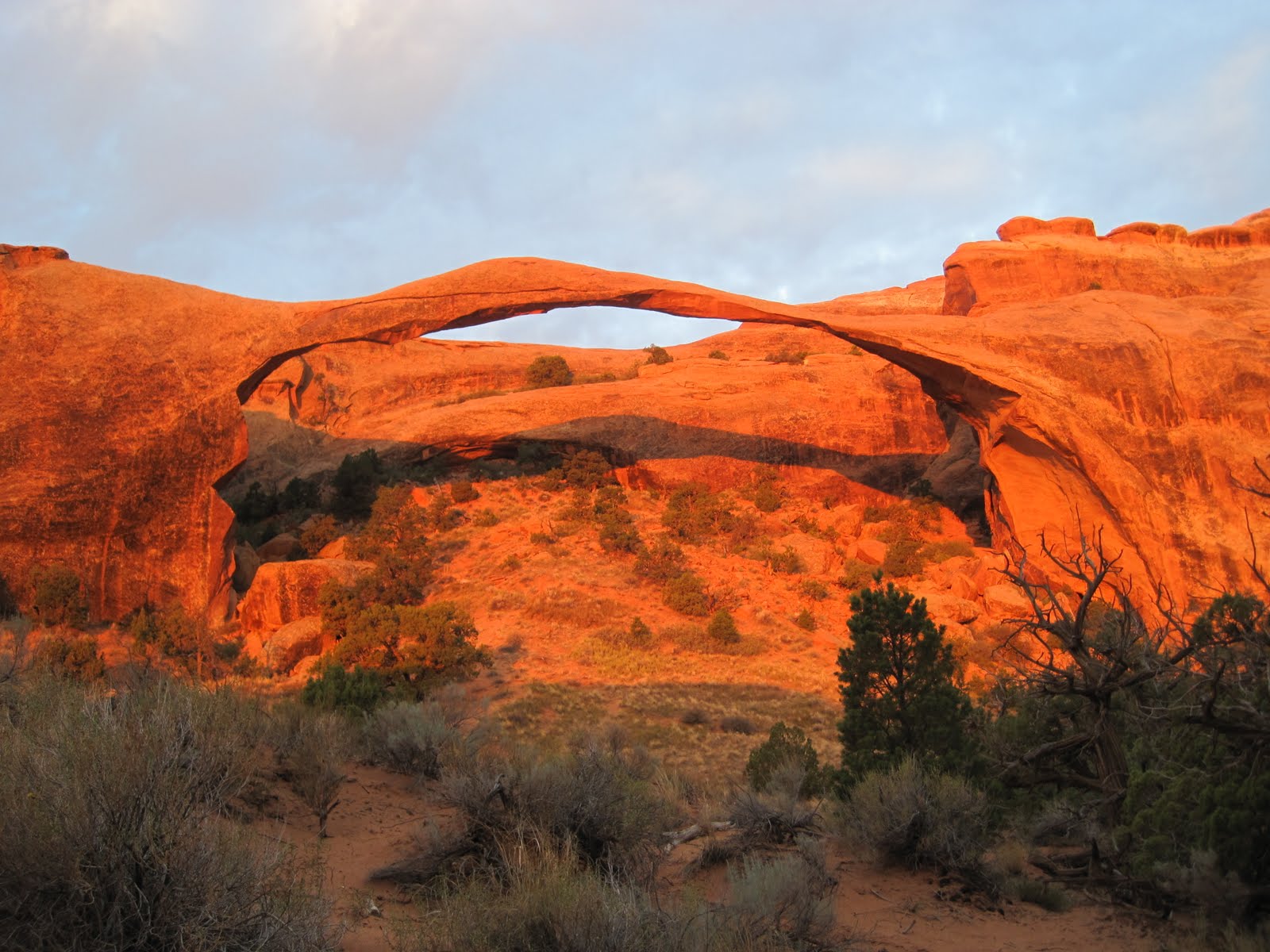
Arches contained, you guessed it, around 2000 natural rock arches in a many coloured desert landscape.  We arrived late, but the full moon illuminated the huge rock formations encircling our sought after campground. A 5am start ensured we arrived at Landscape arch just in time for sunrise, wowsers.  We then packed up our tent (no. 6 in a series of 19 pack ups, - still always accidentally packed something inside the tent) and headed off on one of the many hikes.

Crusty crust!
A word on 'hikes' in national parks.  US citizens are not always known for their svelteness (no sniggering, Canada and UK aren't far behind).  The Parks service recognises this and understandably doesn't want too many coronaries so the 0.3mile tarmacced walk to a sight is INVARIABLY described as a "hike". Which makes it tricky to distinguish between a stroll and an actual lung busting, tendon aggravating hike.  (Rest assured, we found plenty of the latter.)

A ranger led 'hike' through the complex Fiery Furnace left me obsessed with desert crust; tiny bacteria bond together sand grains to, over around 100 years, create soil in which plants can grow.  Destroyed by a single footstep, it takes another century to reform; understandably not realised by early European settlers who couldn't fathom why their cattle quickly desolated what appeared to be dry but sustaining grasslands.

Jumping photo!
A night in the adventure mecca of Moab preceded our next campspot in Canyonlands NP.  A huge distant lightning show and an incredible overlook over the very complex terrain of this park made up for the lack of water tap and stinky toilets.  The only real way to explore is a multi day guided jeep or mountain bike trip (or if you don't mind risking a limb or two you could go solo aka Aron Ralston in 127 hours).

Our tattered western states map was becoming unreadable but we found a gem of a replacement; the National Geographic adventure atlas in a Visitor Centre (yes, we did visit lots and yes, I did have to be torn away).  We followed a scenic highway route through the lunar like landscape of Grand Escalante National Monument and had a bonus stop at our fifth NP, Capitol Reef, named for the huge fold of the earth's crust rearing up like a reef.

Bryce Canyon: It really is that good
Our final 'amazing rock formation' park was Bryce Canyon; not really a canyon (formed by a river) but a series of giant amphitheatres along a high plateau. A sunset hike among the salmon pink rock spires (named hoodoos after voodoo) was breathtaking (particularly as the park is based at over 2,700m elevation). However, it shouldn't surprise you the speed with which a mention of a new species in a park newspaper could give me a deep longing to spot one; the trip could now not be complete without seeing a rare Utah prairie dog (think more meercat than wolf)... A wrong turn on the way out rescued me from despondency as we spotted two little sentries on duty for the colony.  Job done.

Now we headed south again for a real hike: to the bottom of the biggest gash in the earth's surface, the Grand Canyon...